
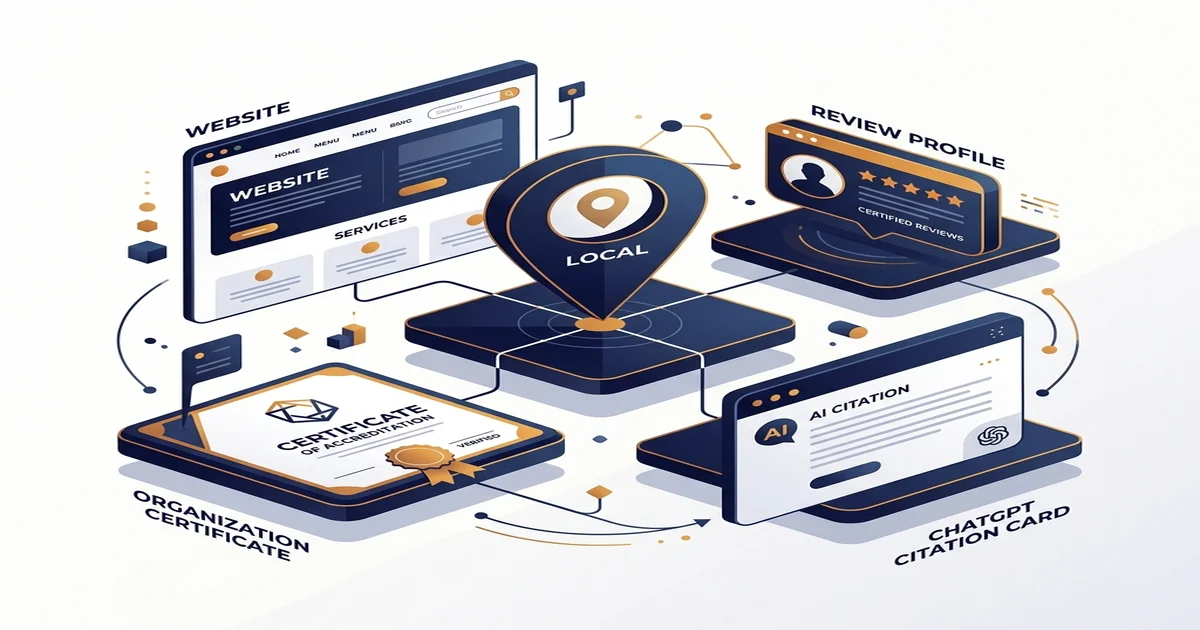

A local business improves its chance of appearing in ChatGPT Search when its website is crawlable, discoverable through search, directly relevant to the user’s service and location, tied to a clear real-world business entity, and supported by verifiable reviews, credentials, profiles, and local proof. No public checklist can guarantee a recommendation, because OpenAI does not publish fixed ranking weights or a guaranteed placement system. The practical goal is to become easy to find, easy to verify, easy to cite, and safe to recommend.
Editorial boundary OpenAI does not publish fixed ranking weights, a citation-selection formula, or a private recommendation score. This guide separates official documentation, an observed local-provider retrieval test, and practical actions that improve crawl access, discovery, relevance, verification, and conversion.
This guide uses three evidence labels:
- Documented behavior: confirmed in official OpenAI, Google, or Bing documentation.
- Observed behavior: recorded during a live Kansas City local-provider search and verification test.
- Practical inference: an action that logically improves discovery, clarity, verification, or conversion, without being presented as a private ChatGPT ranking factor.
| The core principle keyword relevance can put a business into the candidate pool. Independent verification can raise recommendation confidence. Clear factual pages make the business easier to cite. If you want this applied to your own site, a topical authority audit is the fastest way to find the gaps. |
1. What “Ranking in ChatGPT” Means for a Local Business
ChatGPT Search does not present one permanent local ranking list. The result can change with the wording of the prompt, the user’s location, the search queries generated from the prompt, current search results, and the sources available at that moment. A local business should measure four separate outcomes rather than treating visibility as one position.
| Visibility level | What it means | What to measure |
|---|---|---|
| Discovery | ChatGPT or a search provider finds the website, listing, or profile. | Impressions, indexed pages, candidate appearance, crawler access |
| Citation | A page is linked as evidence for a statement in the answer. | Cited URL, supported claim, referral traffic |
| Recommendation | The business is selected as a suitable provider for the user’s request. | Appearance in provider lists, order, stated reason for selection |
| Conversion | The user has enough confidence to call, book, request a quote, or visit. | Calls, forms, bookings, qualified leads, revenue |
These outcomes are connected but not identical. A website may be discovered without being cited. A page may be cited for a price, service, or opening-hour fact without the business being recommended. A business may also be recommended through a well-maintained profile or directory while its own website receives no citation.
2. What OpenAI Publicly Documents About ChatGPT Search
OpenAI states that ChatGPT Search can rewrite a user’s prompt into one or more targeted queries. After reviewing the initial results, it may send additional, more specific queries to search providers. OpenAI also states that general location derived from an IP address may be used to improve local results, and precise device location may be used when a user enables it. [1]
A prompt such as “Who provides mold removal in Kansas City?” can therefore lead to searches around related service, location, urgency, trust, and property-type needs, such as:
- mold-remediation companies in Kansas City
- mold removal Kansas City, Missouri
- mold removal Kansas City, Kansas
- emergency mold-remediation service Kansas City
- residential mold removal near Kansas City
- certified mold-remediation contractors Kansas City
- mold testing and removal Kansas City
- black mold removal Kansas City
- Kansas City mold-removal reviews
The lesson is direct: a site should not rely on one exact keyword. It needs pages and profiles that answer the related questions ChatGPT may search while trying to satisfy the original request — the same principle behind a semantic SEO content model built on a complete topical map.
OpenAI’s public material describes query rewriting, location use, crawler controls, search inclusion, and referral tracking. It does not publish a fixed local ranking formula, citation weight, trust score, or guaranteed placement method. Any guide claiming to know exact ChatGPT local ranking weights is going beyond the public evidence.
3. The Local-Provider Retrieval Pattern Observed in Testing
In a Kansas City mold-removal test, the broad request returned a mixed pool rather than a clean list of providers. The pool included remediation companies, inspection-only firms, directories, government guidance pages, news pages, social profiles, and restoration companies. The search then became more specific, and individual businesses were checked through their websites, public profiles, review sources, and service pages.
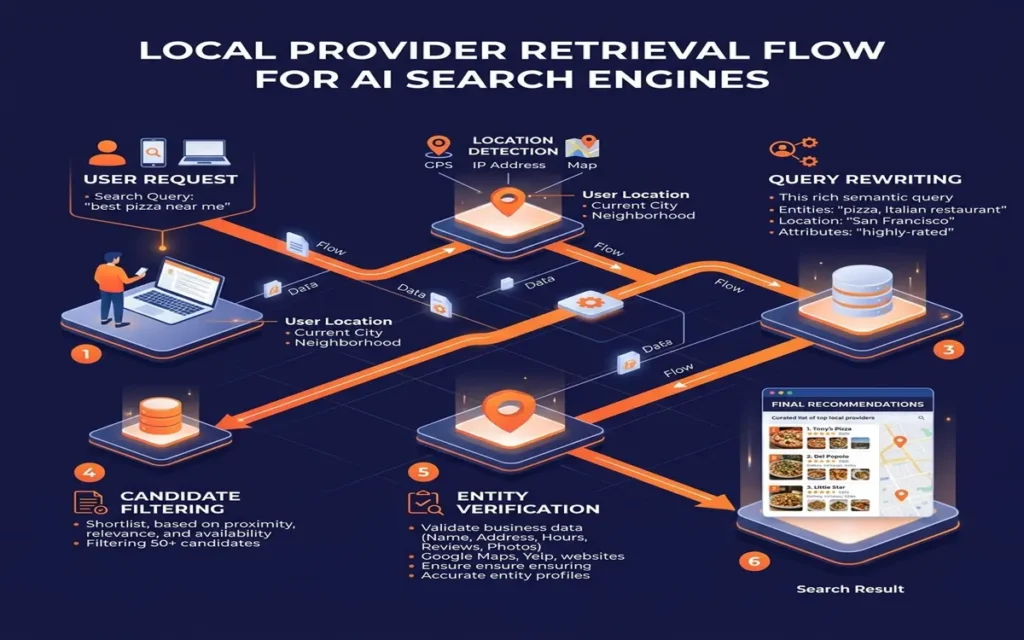
This flow is an observed working model, not a published OpenAI algorithm. It is useful because it shows where a local business can fail: the business may never enter the candidate pool, may not match the exact need, may be hard to connect to a real entity, or may contain claims that cannot be confirmed.
4. Why a Highly Relevant Local Website Can Still Be Missed
The Kansas City test also showed that an exact-match domain can be highly relevant but absent from the initial results. The site was reviewed only after its URL was supplied directly. That does not prove the site was penalized. It shows that relevance alone does not guarantee discovery or recommendation.
A relevant site may be missed when:
- it does not surface for the rewritten search queries;
- its important pages are not indexed or have a limited search footprint;
- it is new and has little external confirmation;
- OAI-SearchBot or another search crawler is blocked;
- the site ranks for one phrase but not service, urgency, trust, or suburb variations;
- business names, phone numbers, addresses, or URLs conflict across profiles;
- the site lacks links connecting it to licensing, reviews, trade bodies, or a registered entity;
- the initial result pool is limited and established competitors occupy it;
- the user’s location changes the candidate set;
- the page matches the words but not the service boundaries or decision criteria.
An exact-match domain can make the subject clear, but the domain name does not prove that the company is established, licensed, insured, reviewed, local, available, or suitable for the user.
5. The Seven-Stage Local ChatGPT Visibility Model
| Stage | Requirement | Failure example |
|---|---|---|
| 1. Crawl eligibility | The page is public and accessible to relevant crawlers. | robots.txt, firewall, CAPTCHA, or noindex blocks access |
| 2. Search discovery | The page or profile appears in search systems used during retrieval. | important URL is not indexed or lacks query coverage |
| 3. Query relevance | The page matches service, location, property type, urgency, and need. | generic page does not state exact service or area |
| 4. Entity resolution | The website connects to one stable real-world business. | conflicting names, numbers, addresses, or legal details |
| 5. Independent verification | Outside sources support reviews, credentials, identity, and service claims. | badges and ratings have no public source |
| 6. Recommendation suitability | The business fits the user’s requirements. | provider does not serve the area or property type |
| 7. Citation suitability | A page directly supports a factual statement in the answer. | marketing language does not prove the stated fact |
A strong local SEO program should audit every stage. Improving only content will not fix a crawler block. Adding reviews will not repair conflicting phone numbers. Schema will not make an unindexed page appear. Each stage has a different job.
6. Technical Foundation: Crawl Access and Indexing
6.1 Allow OAI-SearchBot
OpenAI identifies OAI-SearchBot as the crawler used to surface websites in ChatGPT Search. Sites that opt out will not be shown in ChatGPT Search answers, although a navigational link may still appear in some cases. OpenAI recommends allowing the crawler in robots.txt and allowing requests from its published IP ranges. [2]
| User-agent: OAI-SearchBot Allow: / |
OAI-SearchBot and GPTBot have different purposes. OAI-SearchBot controls search visibility. GPTBot relates to content that may be used to improve OpenAI’s generative models. OpenAI states that these controls are independent. A site can allow search access while blocking GPTBot.
| User-agent: OAI-SearchBot Allow: / User-agent: GPTBot Disallow: / |
OpenAI notes that it can take about 24 hours after a robots.txt update for its search systems to adjust.
6.2 Check the CDN, Firewall, and Bot Protection
A correct robots.txt file does not help when the hosting layer blocks the crawler. Review Cloudflare, hosting security, WordPress security plugins, rate limits, and managed firewall rules. Test for:
- 403 Forbidden responses;
- 429 Too Many Requests responses;
- bot challenges or managed challenge pages;
- CAPTCHA requirements;
- JavaScript or cookie verification before content loads;
- country or IP restrictions;
- session requirements;
- blocked OpenAI IP ranges.
OpenAI publishes OAI-SearchBot’s user-agent string and IP range file. Developers should use the current official file rather than copying an old static list into a firewall rule.
6.3 Audit Priority URLs
Every main service and location page should:
- return HTTP 200;
- load without login or user interaction;
- avoid noindex directives;
- use the intended canonical URL;
- appear in the XML sitemap;
- receive crawlable internal links;
- avoid long redirect chains;
- contain meaningful HTML text;
- work on mobile;
- avoid blocking resources needed to understand the page.
6.4 Inspect Server Logs
Search server or CDN logs for OAI-SearchBot. Record the requested URL, date, status code, response size, redirect destination, and any security rule that fired. Logs can prove access, but they do not prove that a page will rank or be cited.
6.5 Maintain Google and Bing Discovery
OpenAI states that ChatGPT Search may send rewritten queries to search providers, including Bing. Good Bing discoverability is therefore a sensible part of a ChatGPT Search strategy. This is not a statement that Bing rankings map directly to ChatGPT recommendations. It means a page that is absent from the search systems used during retrieval has fewer chances to enter the candidate pool.
Use:
- Google Search Console for Google indexing and query data;
- Bing Webmaster Tools for Bing indexing, inspection, and crawl reports;
- valid XML sitemaps;
- crawlable internal links;
- URL inspection for priority pages;
- IndexNow for added, updated, redirected, or removed URLs.
Bing’s webmaster guidance recommends IndexNow, XML sitemaps, crawlable internal links, and external links as discovery paths. Bing also offers URL submission and inspection tools. [5][6] IndexNow speeds notification; it does not promise indexing or a recommendation.
7. Build a Clear Local Business Entity
A local business needs one stable identity that can be matched across the website and external sources. The system should not have to guess whether two names or numbers refer to the same company.
7.1 Use One Canonical Business Record
Use the same accurate information across the site and public profiles:
- public business name;
- registered legal name, where relevant;
- primary telephone number;
- street address or service-area status;
- city, state, and postal code;
- business email;
- canonical website URL;
- regular and emergency hours;
- owner or leadership details;
- licence and certification numbers;
- insurance status;
- service areas.
Compare the website with Google Business Profile, Bing Places, BBB, Facebook, Yelp, chamber listings, trade associations, licensing databases, and review profiles. A different phone number on the footer, FAQ, schema, and Google profile creates a preventable verification problem.
7.2 Complete the Google Business Profile
Google says local results are mainly based on relevance, distance, and prominence. Accurate profile data, categories, hours, services, reviews, and links support Google local visibility, which can also help a business become easier to discover and verify during wider search retrieval. [4]
Review:
- primary category;
- valid secondary categories;
- business name without added keywords;
- verified address or service-area setup;
- primary phone number and website;
- regular, holiday, and emergency hours;
- service descriptions;
- service areas;
- business description;
- real team, vehicle, office, and project photographs;
- appointment or quote link;
- review responses.
7.3 Connect the Website to Public Evidence
Link from the website to genuine public sources where appropriate, and link those profiles back to the website when the platform permits it. Useful sources include Google Business Profile, Bing Places, BBB, a state licence record, a professional association, a chamber profile, and an established review platform.
| Business name ↕ Official website ↔ Google/Bing business profiles ↕ Address and phone ↔ licence or registration record ↕ Reviews ↔ public review source ↕ Credentials ↔ issuing organization ↕ Service areas ↔ local pages and project proof |
The purpose is not to create hundreds of low-quality citations. The purpose is to make the same real business easy to confirm across several relevant sources.
8. Create Pages That Match Rewritten Local Queries
8.1 Build One Strong Primary Service-and-Location Page
A primary local service page should state the company, service, location, property types, availability, service boundaries, and contact method in the opening section.
| Page element | Example |
|---|---|
| URL | /mold-removal-kansas-city/ |
| SEO title | Mold Removal and Remediation in Kansas City, MO & KS |
| H1 | Mold Removal Services in Kansas City |
| Opening answer | ABC Mold Services provides residential and commercial mold removal across Kansas City, Missouri, Kansas City, Kansas, and nearby communities. Services include inspection, containment, removal, drying, HEPA filtration, and post-remediation support. |
A direct opening is easier to interpret than a generic statement such as “We protect what matters most.” Brand language can follow after the service, location, and operating facts are clear.
8.2 Answer Customer Decision Questions
| Customer question | Information to publish |
|---|---|
| Do you serve my location? | Named cities, suburbs, states, radius, and any travel limits |
| Do you handle my problem? | Specific services, rooms, materials, property types, and exclusions |
| Do you remove it or only inspect it? | Clear boundaries between inspection, testing, removal, remediation, and repair |
| Are you available today? | Hours, emergency policy, booking process, and response conditions |
| What will it cost? | Real price ranges, minimum charges, or factors that change cost |
| Are you licensed or certified? | Issuer, number, status, and direct verification link |
| Are you insured? | Coverage type and any relevant limits |
| What method do you use? | Plain-language process and equipment |
| Will you fix the cause? | Moisture, leak, repair, or reconstruction responsibilities |
| Do you help with insurance? | Exact documentation or claims support offered |
| What happens after the work? | Clearance, warranty, follow-up, and maintenance |
| Can I verify your reputation? | Public review links, case studies, licences, and profiles |
These questions often matter more to a user than a broad “best company” claim. They also give a retrieval system factual criteria for deciding whether the provider fits the request.
8.3 Create Supporting Service Pages
Build separate pages only when the service has its own intent, process, eligibility, pricing, or decision criteria. Examples include emergency service, residential service, commercial service, inspection, testing, removal, remediation, basement work, attic work, water-damage restoration, insurance support, pricing, and post-service testing.
Do not create dozens of pages that replace only the city name. Each page should answer a real customer need and contain distinct proof.
8.4 Build Location Pages for Real Service Areas
A useful location page can include services available there, response expectations, neighbourhood coverage, property conditions, project examples, local reviews, relevant regulations, and the booking process. A thin page that says “We serve [City]” provides little evidence that the company genuinely works there.
8.5 Cover the Query Set, Not One Keyword
| Query group | Example |
|---|---|
| Provider discovery | mold-removal companies in Kansas City |
| Service | mold remediation Kansas City |
| Problem | black mold removal Kansas City |
| Property type | commercial mold removal Kansas City |
| Urgency | emergency mold removal near me |
| Price | mold-removal cost Kansas City |
| Trust | certified mold-remediation company Kansas City |
| Reviews | well-reviewed mold-removal company Kansas City |
| Suburb | mold removal Overland Park |
| Comparison | mold inspection versus remediation |
| Qualification | licensed mold contractor Kansas City |
| Process | how mold remediation works |
| Availability | same-day mold-removal service |
9. Make Pages Suitable for Citations
A citation supports a specific statement. The cited page should show the company, the fact, and the context clearly. If an answer says a company offers 24-hour emergency service across Kansas City, the source page should state all three facts. “We are always here for you” is not strong evidence for 24/7 availability.
9.1 Add Visible Fact Blocks
| Business fact | Example value |
|---|---|
| Business name | ABC Mold Services LLC |
| Main service | Mold inspection and remediation |
| Coverage | Kansas City, MO; Kansas City, KS; named suburbs |
| Property types | Homes, offices, rental properties, and selected industrial sites |
| Hours | Monday-Sunday; emergency line available 24 hours |
| Phone | One verified number |
| Credentials | Issuer, certificate number, and verification URL |
| Insurance | Named coverage type |
| Reviews | Linked public review source and dated count |
| Updated date | Visible reviewed or modified date |
| Service fact | Status or detail |
|---|---|
| Inspection | Included or separate service |
| Moisture detection | Included |
| Containment | Included when required |
| HEPA filtration | Equipment and conditions stated |
| Material removal | When required |
| Drying | Included or referred |
| Reconstruction | Included, subcontracted, or excluded |
| Clearance testing | State whether it is independent |
| Insurance documentation | State the level of support |
Tables are not a published ChatGPT ranking factor. They are useful because they reduce ambiguity for users and make business facts easier to scan, compare, and extract.
9.2 Connect Every Trust Claim to Its Source
Local service websites often weaken their own credibility by publishing badges and numbers without verification. Use these rules:
- Link review ratings to the public review profile.
- Display the date when a review count or rating was checked.
- Link certifications to the issuing organization or public directory.
- Show licence and certificate numbers where public verification is available.
- Link BBB accreditation claims to the matching business profile.
- Do not label onsite testimonials as “verified reviews” unless the verification method is explained.
- Remove sample phone numbers, template reviews, and placeholder badges.
- Keep legal name, address, phone, hours, and profile details consistent.
- Repair broken Terms, Privacy, Contact, review, and credential links.
| One-click verification standard
A visitor should be able to move from a claim on the website to its public source in one click whenever a public verification source exists. |
9.3 Replace Promotion with Checkable Facts
| Weak wording | Stronger wording |
|---|---|
| We are the best mold-removal company in Kansas City. | We have completed 312 documented remediation projects since 2021. |
| Top-rated local experts. | Rated 4.8 from 186 Google reviews as checked in June 2026. |
| Fully certified. | IICRC certification number 12345, active through December 2026, verified on the IICRC public directory. |
| Fast response. | Emergency calls are answered 24 hours a day; arrival time varies by location, weather, and crew availability. |
| 100% satisfaction guaranteed. | Warranty terms, exclusions, duration, and claim process are available here. |
Avoid fake ratings, placeholder licence numbers, unsupported “number one” claims, invented project counts, unverifiable certifications, false response times, and accreditation claims without a matching profile.
9.4 Keep Citation Pages Focused
A citation-ready page normally has a descriptive title, one clear H1, a direct opening answer, short paragraphs, specific headings, visible business facts, a stable URL, service coverage, price information, qualifications, updated dates, named authors or reviewers where relevant, and links to supporting records. Do not hide essential facts only inside sliders, images, pop-ups, video, or downloadable files.
10. Build Recommendation Confidence
A provider can be a strong keyword match but a weak recommendation. Recommendation confidence rises when the service fit and location fit are backed by stable business data and independent proof.
| Signal | Business A | Business B |
|---|---|---|
| Exact service match | Strong | Strong |
| Exact location match | Strong | Strong |
| Official website | Yes | Yes |
| Consistent phone | No | Yes |
| Public reviews | Limited or unclear | Strong |
| Licence confirmation | Unclear | Confirmed |
| Business history | Unclear | Documented |
| External references | Few | Several relevant sources |
| Recommendation confidence | Lower | Higher |
10.1 Build Independent Corroboration
Useful sources can include:
- Google Business Profile and Bing Places;
- BBB or another relevant business accreditation source;
- state licensing and company registration databases;
- trade associations and professional directories;
- chambers of commerce;
- manufacturer, supplier, or approved-contractor directories;
- local news coverage;
- property management, insurance, or partner references;
- established review platforms;
- local sponsorship or community pages with a genuine relationship;
- industry awards with published criteria.
The aim is not volume. A small set of strong, consistent sources is more useful than hundreds of generic listings that repeat unverified data.
10.2 Publish Real Local Case Studies
A useful case study can show the city or neighbourhood, property type, problem, inspection findings, work completed, method, duration, limitations, result, project photographs, customer review source, technician, and month and year. Do not publish private addresses or customer details without permission.
10.3 Develop a Genuine Review Footprint
Ask customers for honest feedback after completed work. Do not give every customer the same keyword-heavy script. A natural prompt can ask them to describe the service, location, and what stood out. Track review recency, source, service type, and location. Respond to positive and negative reviews with factual language and without disclosing private customer information.
11. Structured Data and Developer Implementation
Google states that LocalBusiness structured data can describe business details such as location and opening hours, while Organization structured data can help disambiguate an organization and its administrative details. Structured data can support machine understanding, but OpenAI does not list schema as a guaranteed ChatGPT citation or recommendation factor.
11.1 LocalBusiness Markup Example
| <script type=”application/ld+json”> { “@context”: “https://schema.org”, “@type”: “LocalBusiness”, “@id”: “https://example.com/#business”, “name”: “ABC Mold Services”, “legalName”: “ABC Mold Services LLC”, “url”: “https://example.com/”, “telephone”: “+1-816-555-0123”, “email”: “[email protected]”, “image”: “https://example.com/images/team.jpg”, “priceRange”: “$$”, “address”: { “@type”: “PostalAddress”, “streetAddress”: “123 Example Street”, “addressLocality”: “Kansas City”, “addressRegion”: “MO”, “postalCode”: “64101”, “addressCountry”: “US” }, “areaServed”: [ {“@type”: “City”, “name”: “Kansas City”}, {“@type”: “City”, “name”: “Overland Park”} ], “openingHoursSpecification”: [{ “@type”: “OpeningHoursSpecification”, “dayOfWeek”: [ “Monday”, “Tuesday”, “Wednesday”, “Thursday”, “Friday”, “Saturday”, “Sunday” ], “opens”: “00:00”, “closes”: “23:59” }], “sameAs”: [ “[GOOGLE BUSINESS PROFILE URL]”, “[BING PLACES OR VERIFIED PROFILE URL]”, “[BBB OR TRADE PROFILE URL]” ] } </script> |
Use only accurate facts that are visible on the page. Test the markup and monitor Search Console after template changes. Google recommends validation and states that structured data should describe the page content.
11.2 FAQ Content and FAQ Schema
A well-written FAQ section can answer customer objections and support citation-ready facts. FAQ schema is not a ChatGPT shortcut. Google currently limits FAQ rich results mainly to well-known government and health sites, so a normal local business should write FAQs for users and content clarity rather than expecting a search feature.
11.3 Treat llms.txt as Optional
OpenAI’s public Search guidance focuses on OAI-SearchBot access, crawlability, discoverability, relevance, and referral tracking. It does not state that an llms.txt file is required for ChatGPT Search ranking. An llms.txt file may be used as an optional site guide, but it should not replace indexable pages, internal links, public profiles, verifiable claims, and search visibility.
12. Track ChatGPT Visibility and Business Results
12.1 Track Referral Traffic
OpenAI states that ChatGPT referral URLs include the parameter utm_source=chatgpt.com. Create an analytics segment for that source and measure landing pages, calls, forms, bookings, lead quality, and revenue.
| Source / medium filter: utm_source = chatgpt.com Recommended events: phone_click quote_form_submit booking_complete email_click directions_click qualified_lead revenue |
12.2 Track Crawling Separately
Referral analytics show user visits. Server logs show crawler access. Maintain separate reports for OAI-SearchBot requests, response codes, crawled URLs, blocked pages, and pages that receive no crawler visits.
12.3 Use a Fixed Prompt Test Set
Run the same prompts monthly from a recorded location and device context where possible. Log discovery, recommendation, and citation separately.
- Who provides [service] in [city]?
- Best [service] companies in [city]
- Emergency [service] near [city]
- Licensed [service] providers in [city]
- Well-reviewed [service] company in [city]
- Affordable [service] company in [city]
- Commercial [service] contractor in [city]
- [Specific service] in [suburb]
| Test field | Record |
|---|---|
| Prompt | Exact wording |
| Date and location | When and where the test ran |
| Business discovered | Yes or no |
| Business recommended | Yes or no and answer position |
| Website cited | Yes or no |
| Cited page | Exact URL |
| Supported claim | What the source was used to prove |
| Competitors | Businesses that appeared |
| Sources used | Websites, profiles, directories, reviews |
| Missing facts | Information that could not be confirmed |
| Action | Page, profile, proof, or technical fix |
Results can vary because ChatGPT may rewrite prompts, use location context, and retrieve a different set of current results. A test is a snapshot, not a permanent rank report.
13. A 90-Day Local ChatGPT SEO Action Plan
| Period | Main work |
|---|---|
| Days 1-15 | Audit OAI-SearchBot access, robots.txt, firewall, status codes, noindex, canonicals, sitemaps, Google/Bing indexing, NAP, legal details, and profile ownership. |
| Days 16-30 | Improve the homepage and primary service-location page; add direct opening answers, visible facts, service boundaries, pricing factors, credentials, review links, and LocalBusiness markup. |
| Days 31-60 | Build high-intent service pages and selected location pages; publish local case studies; add team profiles; verify licences; improve profiles; request genuine reviews. |
| Days 61-90 | Build relevant local references; track OAI-SearchBot and ChatGPT referrals; run prompt tests; compare competitor sources; fix missing facts; update pages based on evidence. |
14. Common Reasons a Local Business Is Omitted
- OAI-SearchBot is blocked by robots.txt, the firewall, or a bot challenge.
- Priority service pages are not indexed in the search systems used during retrieval.
- The site does not surface for rewritten service, suburb, urgency, price, or trust queries.
- The business identity is unclear or conflicts across profiles.
- Phone numbers, addresses, opening hours, or URLs do not match.
- The website does not state service boundaries or property types.
- Review counts or ratings cannot be verified.
- Certification, licence, insurance, or BBB claims have no public source.
- Local pages repeat generic copy without projects, reviews, or area-specific detail.
- Important facts exist only inside images or scripts.
- Legal, contact, credential, or review links are broken.
- The business is relevant, but established competitors have stronger public proof.
15. Local ChatGPT Visibility Audit Checklist
| Audit area | Pass condition |
|---|---|
| Crawl access | OAI-SearchBot allowed; firewall permits published IP ranges; pages return 200 |
| Indexing | Priority URLs indexed in Google and Bing; sitemap and internal links working |
| Entity | One business name, legal name, phone, address/service area, email, and URL |
| Profiles | Google Business Profile and Bing Places claimed, accurate, and active |
| Relevance | Primary service-location page directly answers service, city, property type, and urgency |
| Service coverage | Supporting pages cover genuine high-intent services and locations |
| Citation readiness | Facts are visible, dated, specific, and supported by source links |
| Trust | Reviews, licences, certifications, insurance, and accreditation are verifiable |
| Local proof | Case studies, photos, reviews, and projects show real work in the area |
| Schema | LocalBusiness/Organization markup is accurate, visible, and validated |
| Tracking | ChatGPT referrals, crawler logs, prompt tests, leads, and revenue are recorded |
16. Frequently Asked Questions
Does ChatGPT have a fixed local ranking position?
No public fixed position exists. Results can change with the prompt, location, current search results, query rewriting, and available sources.
Will allowing OAI-SearchBot make my business rank?
It makes the site eligible for search crawling and inclusion, but it does not guarantee discovery, citation, or recommendation.
Do I need to allow GPTBot to appear in ChatGPT Search?
No. OpenAI states that OAI-SearchBot and GPTBot controls are independent. A site can allow SearchBot while disallowing GPTBot.
Does an exact-match domain help?
It can make the topic clear, but it does not prove business identity, reputation, credentials, location, or service quality.
Are reviews a direct ChatGPT ranking factor?
OpenAI does not publish a review-weight formula. Public reviews can still help users and retrieval systems verify that the business exists and has served customers.
Does schema guarantee a ChatGPT citation?
No. Schema can clarify business data for search systems, but OpenAI does not publish it as a guaranteed citation factor.
How can I track visits from ChatGPT?
Filter analytics for utm_source=chatgpt.com, then connect the traffic to calls, forms, bookings, qualified leads, and revenue.
How long will improvement take?
Crawler-rule changes may take about 24 hours to be reflected by OpenAI, but indexing, external verification, review growth, content coverage, and recommendation visibility can take much longer.
Conclusion
Local visibility in ChatGPT Search is not a separate trick that replaces local SEO. It depends on a chain: the business must be accessible, found, matched to the user’s need, connected to a clear entity, verified through reliable sources, supported by citation-ready pages, and able to convert the visit.
The most useful working formula is:
| Crawlable website + Search discovery + Exact service and location relevance + Clear business identity + Consistent contact information + Verifiable reviews and credentials + Local project proof + Citation-ready pages + Regular prompt and conversion testing = A stronger chance of discovery, citation, and recommendation |
The standard to aim for is simple: make every important business claim easy to find, easy to understand, and easy to verify.
Propagate the Intel
Transmission Feed