
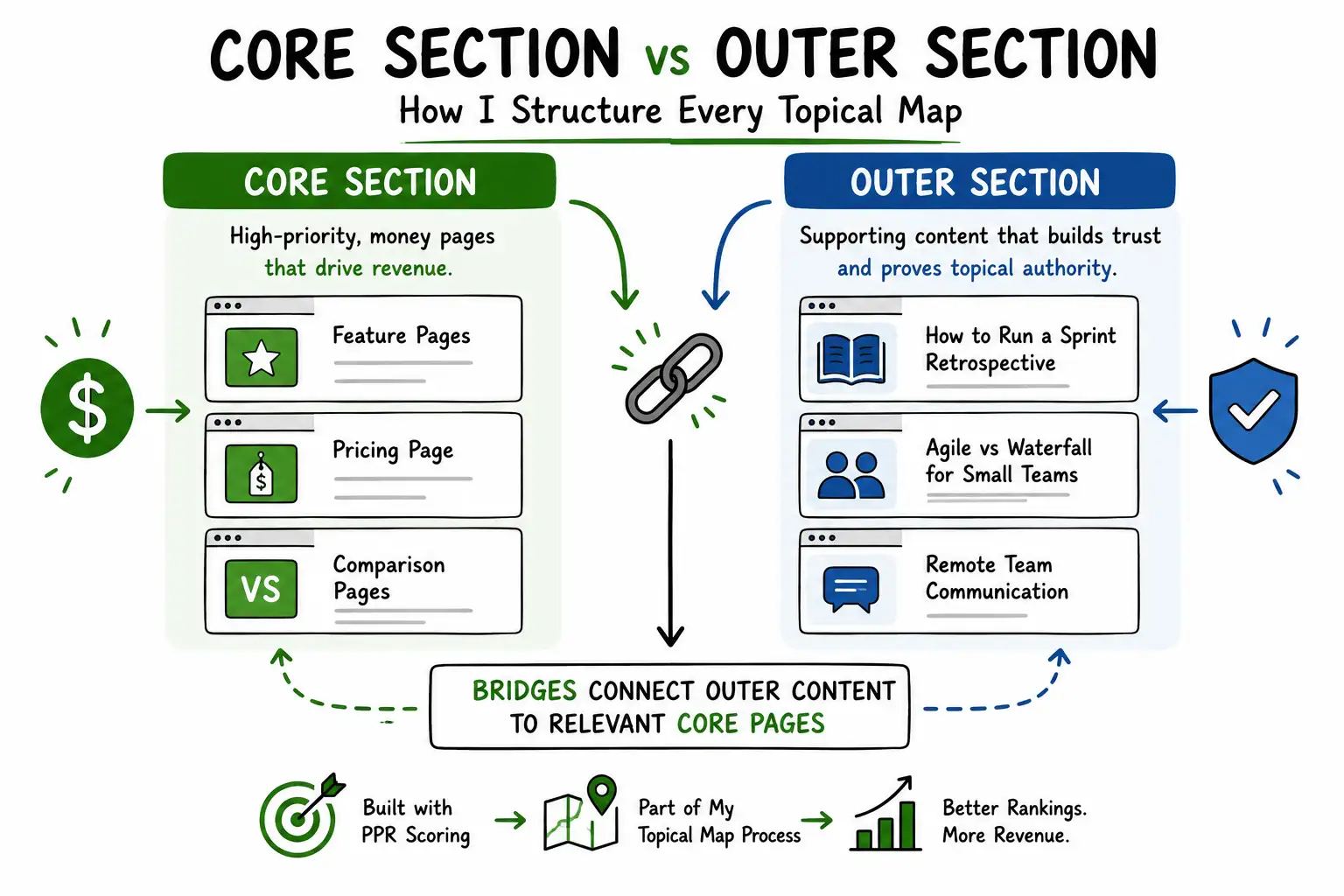

The Core Section holds the topics I score highest for Prominence and Relevance to a client’s Source Context, the pages that carry most of the internal linking weight and most of the monetization. The Outer Section holds everything that supports those pages without converting directly. These are the last 2 of the 5 fundamentals I apply on every project, and once a topic clears PPR scoring, this is where it ends up.
What I Put in the Core Section
The Core Section is where a client’s highest-scoring topics live, the ones that clear the PPR threshold with strong Prominence and Relevance. For a project management SaaS client, that’s the feature pages, the pricing page, the head-to-head comparisons against competitors. I build the entire internal linking structure around these pages, because they’re the ones I actually want ranking.
What I Put in the Outer Section
The Outer Section is everything else that clears PPR scoring without driving revenue directly, content that proves to Google the site understands its subject completely. For that same SaaS client, that’s articles like “how to run a sprint retrospective” or “agile vs waterfall for small teams.” These pages build historical data over time and route trust back to the Core Section through internal links.
The Mistake I See Most Often With the Outer Section
Clients rarely skip the Core Section, it’s obviously tied to revenue, so it gets built carefully. The Outer Section is where I see most topical maps fall apart, not because anyone decided to skip it, but because it got built ad hoc, page by page, based on whatever a writer remembered, instead of systematically against every attribute connected to the Central Entity.
I’ve inherited accounts with an Outer Section that covers the same 2 or 3 attributes 4 times over while entire categories go untouched. The fix is a systematic pass: take every attribute I identified during Source Context and Central Entity work, and check that each one has real Outer Section coverage before I call the section done.
How I Connect the Two: Bridges
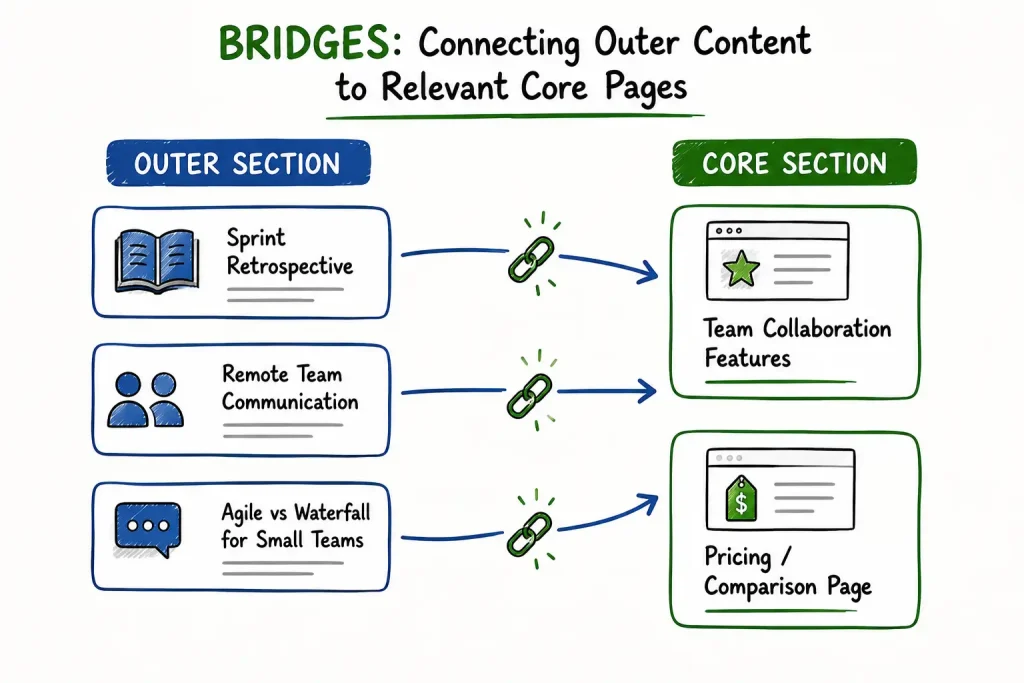
A topical map isn’t 2 separate lists. I connect Core and Outer Sections through bridges, internal links placed because the linking page’s topic genuinely relates to the linked page’s topic, not because a sitemap needed one more connection. An Outer Section page about sprint retrospectives should link to the Core Section page about team collaboration features, because the topics are actually connected. Without bridges like this, I’ve seen Core and Outer Sections sit next to each other without reinforcing one another at all.
An Example From My Own Process
For that same SaaS client: Core Section gets “Best Project Management Software for Small Teams” (PPR 9.2) and “Project Management Software Pricing Comparison” (PPR 8.2), both close to a buying decision. Outer Section gets “How to Write a Project Charter” (PPR 6.0) and “Remote Team Communication Best Practices” (PPR 5.0), both supporting the Central Entity without converting directly, both linking back to relevant Core pages through proper bridges.
Want a Topical Map Built This Way?
Every map I build separates Core and Outer Sections properly, then connects them through real bridges, not generic internal links. If that’s the process you want for your site, see my semantic SEO consulting page.
Work With MeFrequently Asked Questions
Can a topic move from Outer to Core later?
Yes. If a supporting product line becomes central to a client’s business, I rescore it and move it into the Core Section, updating the internal linking to match.
What happens if a client only wants a Core Section?
It can still rank for its core topics, but without an Outer Section building historical data, that ranking tends to plateau. I always push back on Core-only requests for this reason.
Is the Outer Section just a blog?
Not necessarily. It’s a strategic classification, not a format. Some Outer Section content lives on a blog, some is resource pages or guides, as long as it’s PPR-scored and connected to the Core Section through bridges.
Propagate the Intel

Transmission Feed