
arrow_back All Case Studies
Prop Firm Affiliate
YMYL · Financial
Topical Map
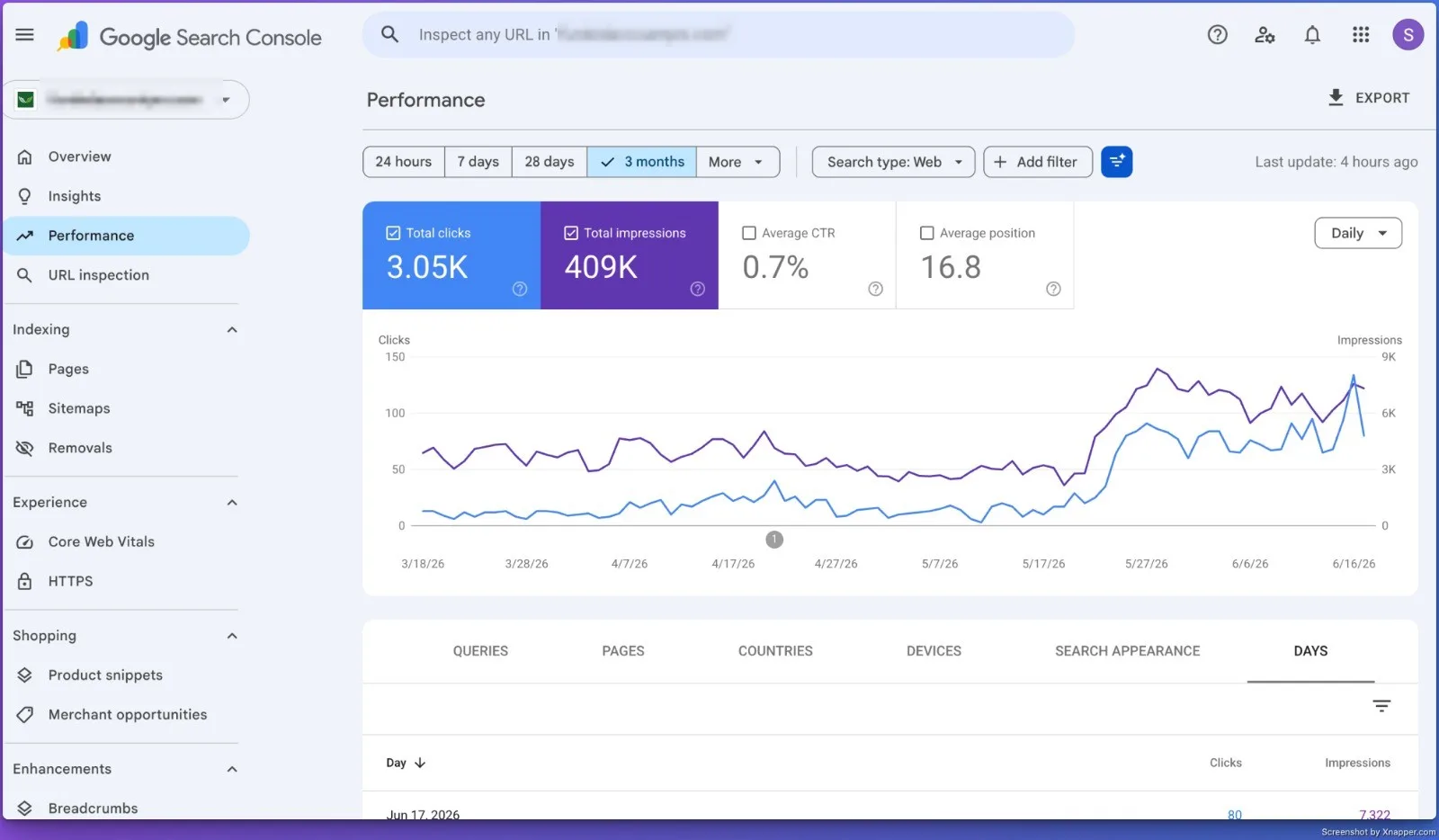
409K Impressions & 100+ Daily Clicks With Zero Backlinks
How a 3-section topical map and Koray Tuberk Gübür's topical authority framework ranked a YMYL prop trading affiliate site in one of the internet's most competitive niches — with no link building, no guest posts, and no off-page SEO.
409K
Impressions
100+
Clicks / Day
0
Backlinks
<12
Months
Project at a Glance
Niche
Prop trading firms (affiliate)
Classification
YMYL — Your Money / Your Life
Timeline
Under 12 months
Topics Published
~90 across 3 sections
Firm Entities
30+ prop firms covered
Off-Page SEO
Zero — no link building
Avg. Position
16.8
Ranking Queries
1,000+
Total Clicks
3,050 (3-month snapshot)
The Challenge
Rank an affiliate site covering 30+ prop firm entities in a YMYL financial niche — with a limited content budget and no off-page SEO resources. Prop firm affiliate SEO sits at the intersection of three high-difficulty factors that make it one of the hardest niches to rank in organically.
1. It's a YMYL niche
Google applies heightened scrutiny to financial content under its Quality Rater Guidelines. Sites covering topics that affect a person's financial wellbeing must demonstrate strong E-E-A-T (Experience, Expertise, Authoritativeness, Trustworthiness). Thin content, vague claims and low-quality reviews don't rank here — they get filtered.
2. The SERP is dominated by aggregators
Affiliate publishers often outrank the brands they promote for commercial terms, and around 70% of all affiliate traffic comes from organic search. A new affiliate site competes directly against established comparison portals with years of domain authority and thousands of referring domains.
3. The niche expanded, then contracted
In 2024, an estimated 80–100 proprietary trading firms exited the market. Despite that, search volume for "prop firm" and related terms grew more than 600% over four years. The audience is growing while the supply of reliable information is inconsistent — and that gap is exactly where topical authority wins.
The Strategy: Topical Authority Over Raw Link Volume
Most prop firm affiliate sites target the highest-volume keywords, publish a "best prop firms" list, add affiliate links, and wait. In a market this nuanced, that approach is especially weak.
Instead of chasing individual keywords, I mapped the entire topic space around prop trading firms as a semantic entity network. Every page is a node. Every node has a purpose. The topical map covered the full decision journey of a trader evaluating funded-account programs — from awareness and comparison through to platform-specific research and challenge-structure analysis. The foundation was Koray Tuberk Gübür's topical authority framework, applied to an affiliate content architecture across multiple firm entities.
Phase 1 — SERP analysis & semantic gap identification
Before writing a single word, I studied the top-ranking pages for the highest-intent prop firm queries. Two patterns emerged. First, visual semantic clarity is a ranking factor in this niche — top pages presented challenge rules, drawdown limits, profit splits and platform compatibility in clean, scannable tables, not walls of text. Second, entity coverage depth separated positions 1–3 from everything else: those pages covered each firm's challenge phases, account sizes, payout schedules, restricted instruments, platform compatibility (MT4, MT5, cTrader), geographic restrictions and trust signals in depth.
The 3-Section Topical Map Architecture
The central decision was how to organize 30+ firm entities plus all surrounding informational and commercial content into a coherent semantic structure. I designed a 3-section topical map with ~90 total topics distributed by content type, semantic intent and topical function.
Section 1 — Entity pages (firm-level nodes)
Each prop firm received a complete entity page — not a thin review — covering every relevant attribute:
- Challenge structure (1-phase, 2-phase, instant funding)
- Account sizes, pricing and profit-split percentages
- Maximum drawdown rules (daily and total)
- Trading restrictions (news trading, EAs, overnight positions)
- Platform compatibility (MT4, MT5, cTrader, proprietary)
- Payout schedule, withdrawal methods and trust signals
The goal: each page is the single most complete source about that specific firm for a searcher who has already decided to research it.
Section 2 — Listicle & comparison pages (commercial intent)
The second section targeted "best of" and "which" buyer-intent queries — best prop firms for beginners, cheapest challenges, instant funding, MT5 support, free trials, highest profit split, 5K and 10K funded programs, and more. Each listicle featured the Section 1 entity pages as listed items, creating a natural internal-link flow from commercial pages down to entity detail pages.
Section 3 — Informational blog layer (topical depth)
The third section covered the concepts and terminology surrounding prop trading decisions — how challenges work, drawdown rules, MT4 vs MT5, binary funded accounts, payout structures, how to pass a challenge. These captured early-research traffic and strengthened the domain's entity association with the prop-trading knowledge space.
Content production & UX
Production focused on three things: entity attribute completeness (missing attributes create topical gaps that phrase-based indexing registers), visual semantic structure (challenge details in comparison tables, key specs above the fold), and a coherent internal link architecture following the 3-section structure — so relevance signals were established without a single external backlink.
Why 90 topics was enough
The client had a limited content budget. Rather than produce more pages of the same generic type, we produced fewer pages that each covered their topic completely and together formed semantically complete coverage of the topic space. A site with 90 pages that collectively cover every attribute, entity, comparison dimension and informational query will outperform a site with 500 thin pages targeting isolated keywords.
Results Over 12 Months
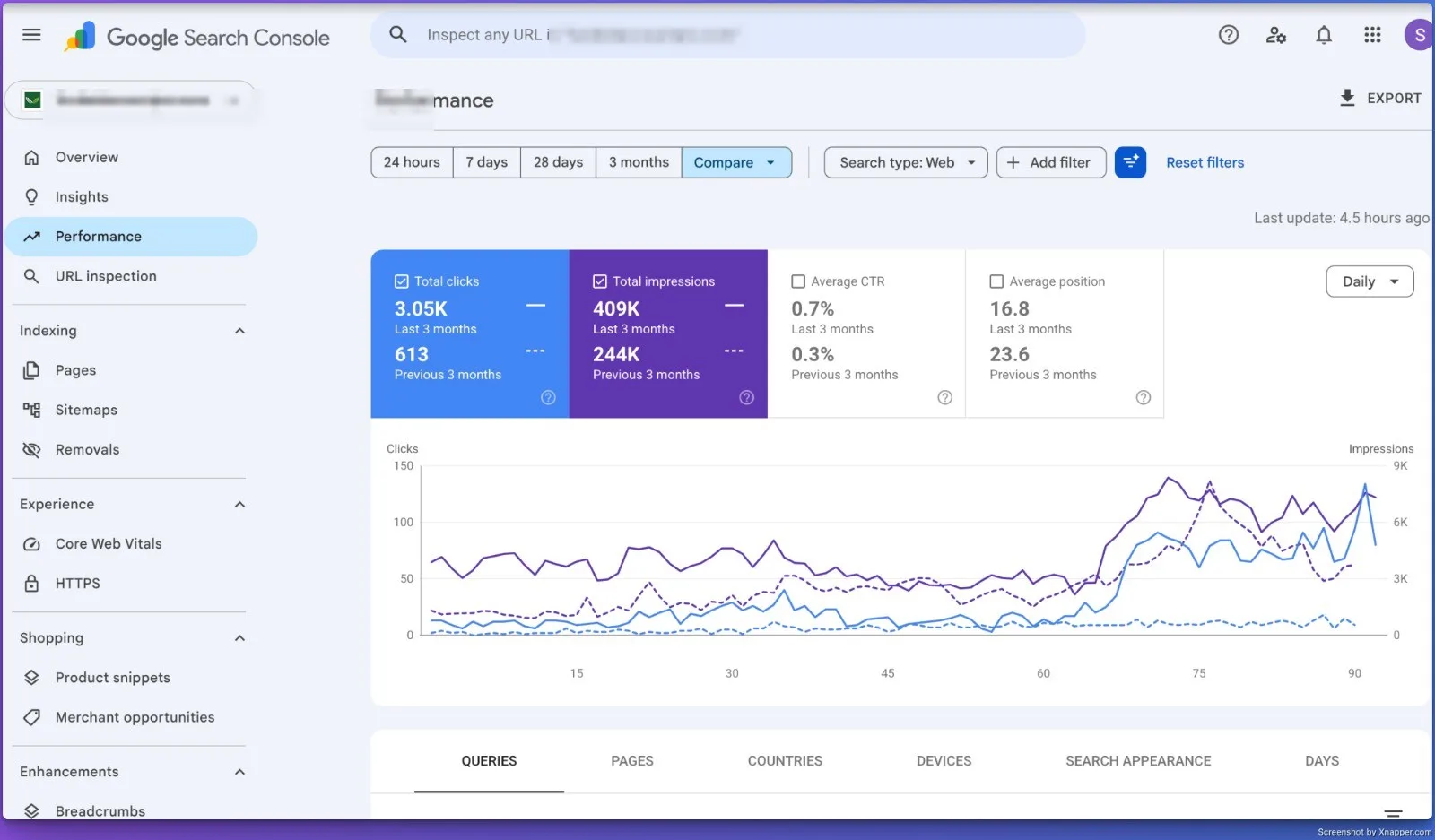
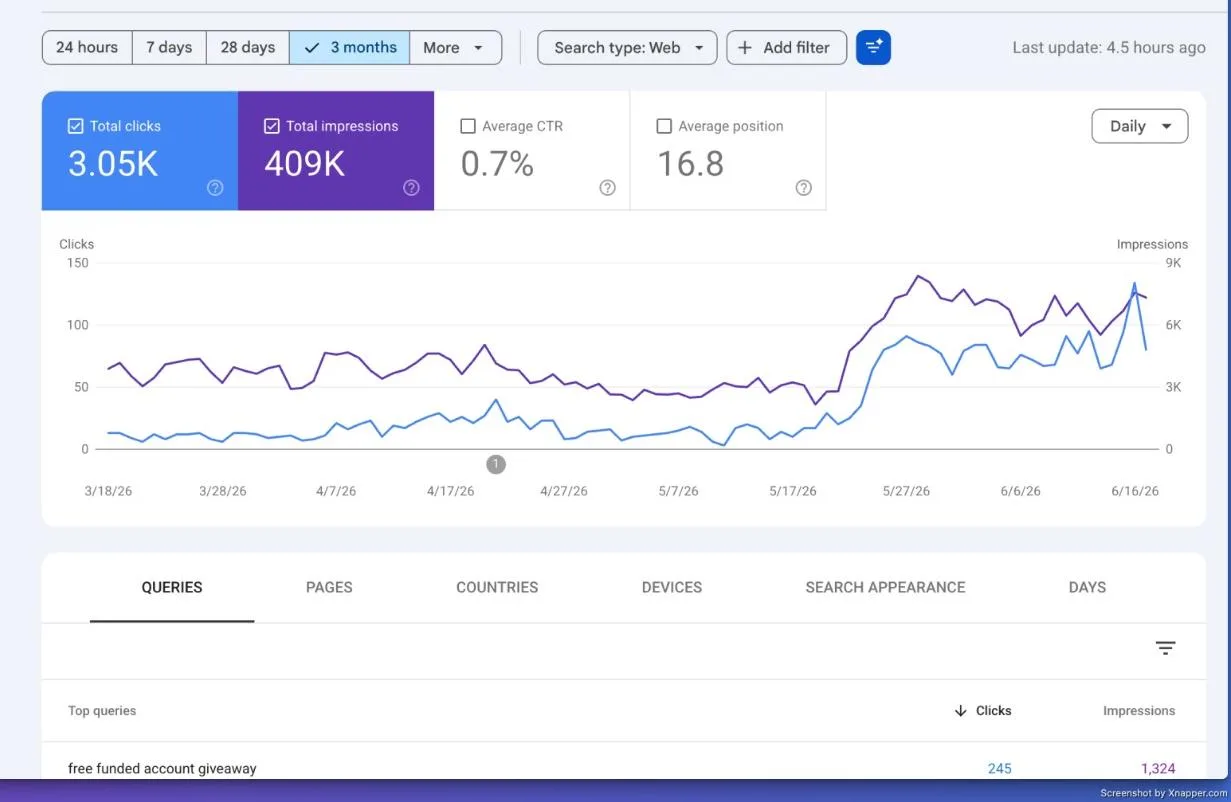
The site launched with no domain history, no backlinks and no paid traffic. Rankings appeared within 2–3 months for long-tail queries; by month 6 entity pages ranked for firm-specific research queries; by month 9 the site generated consistent daily traffic across all three sections.
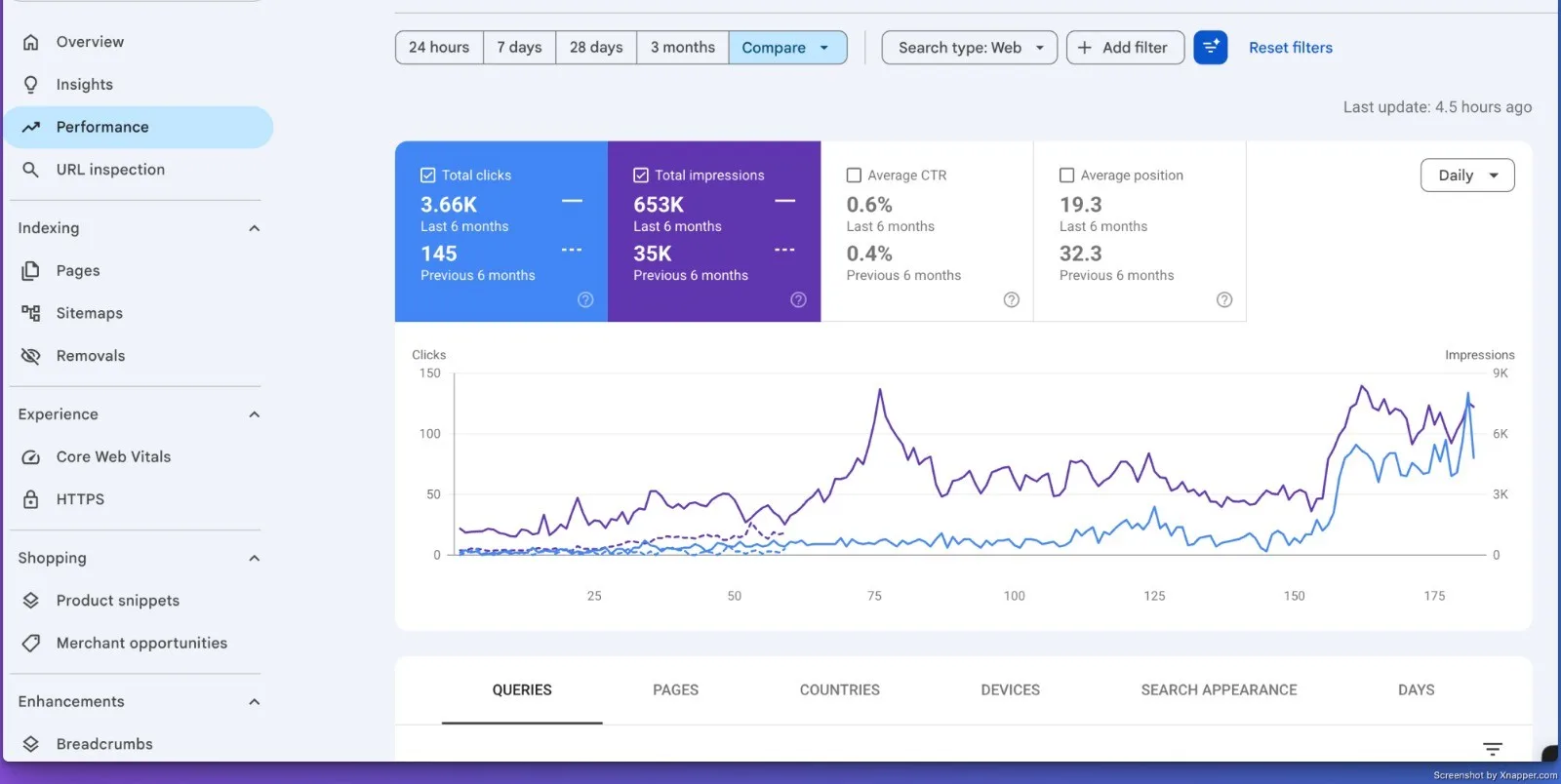
409,000
Total impressions
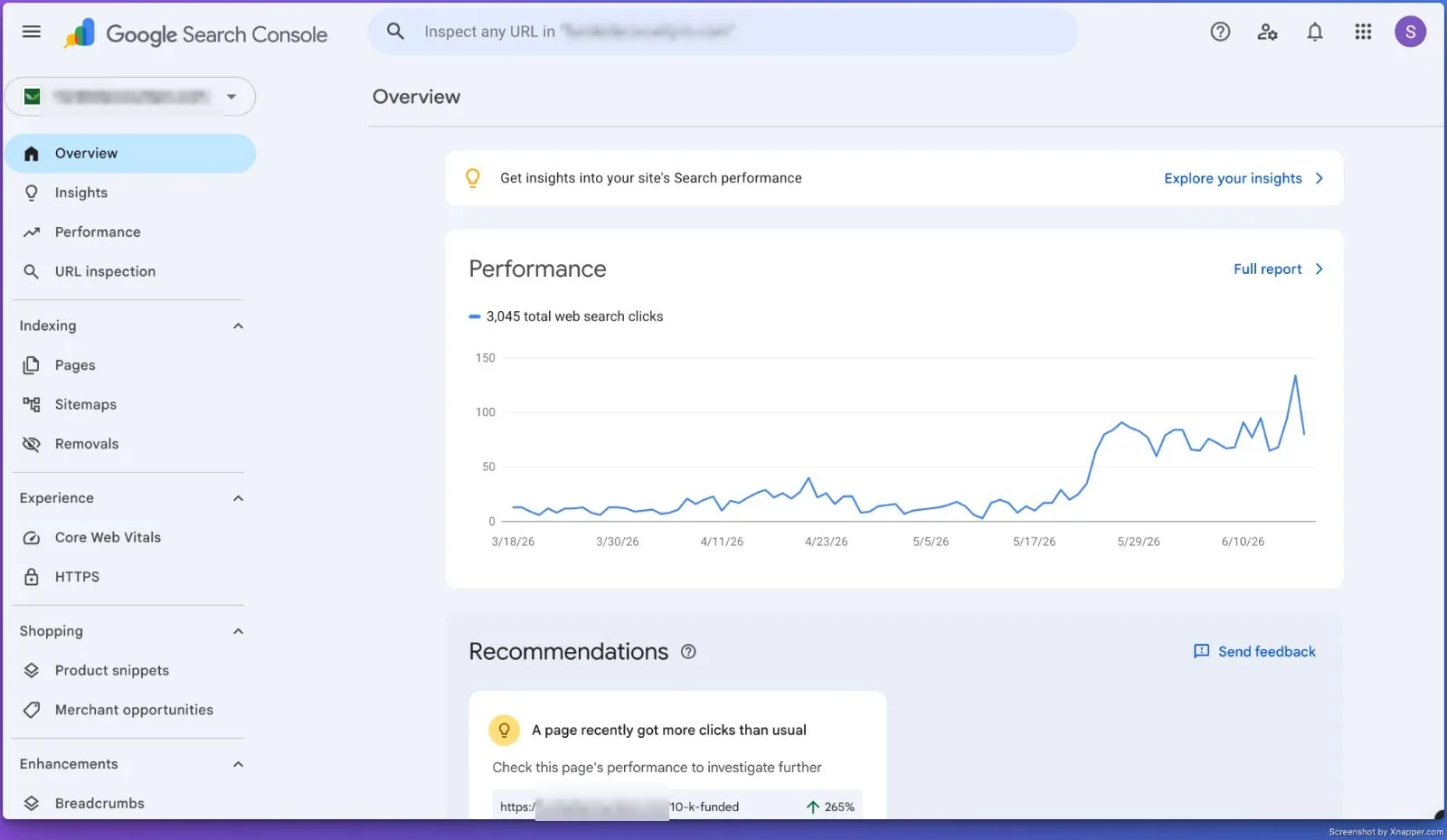
3,050
Total clicks
100+
Avg. daily clicks
1,000+
Ranking queries
16.8
Avg. position
0.7%
Avg. CTR
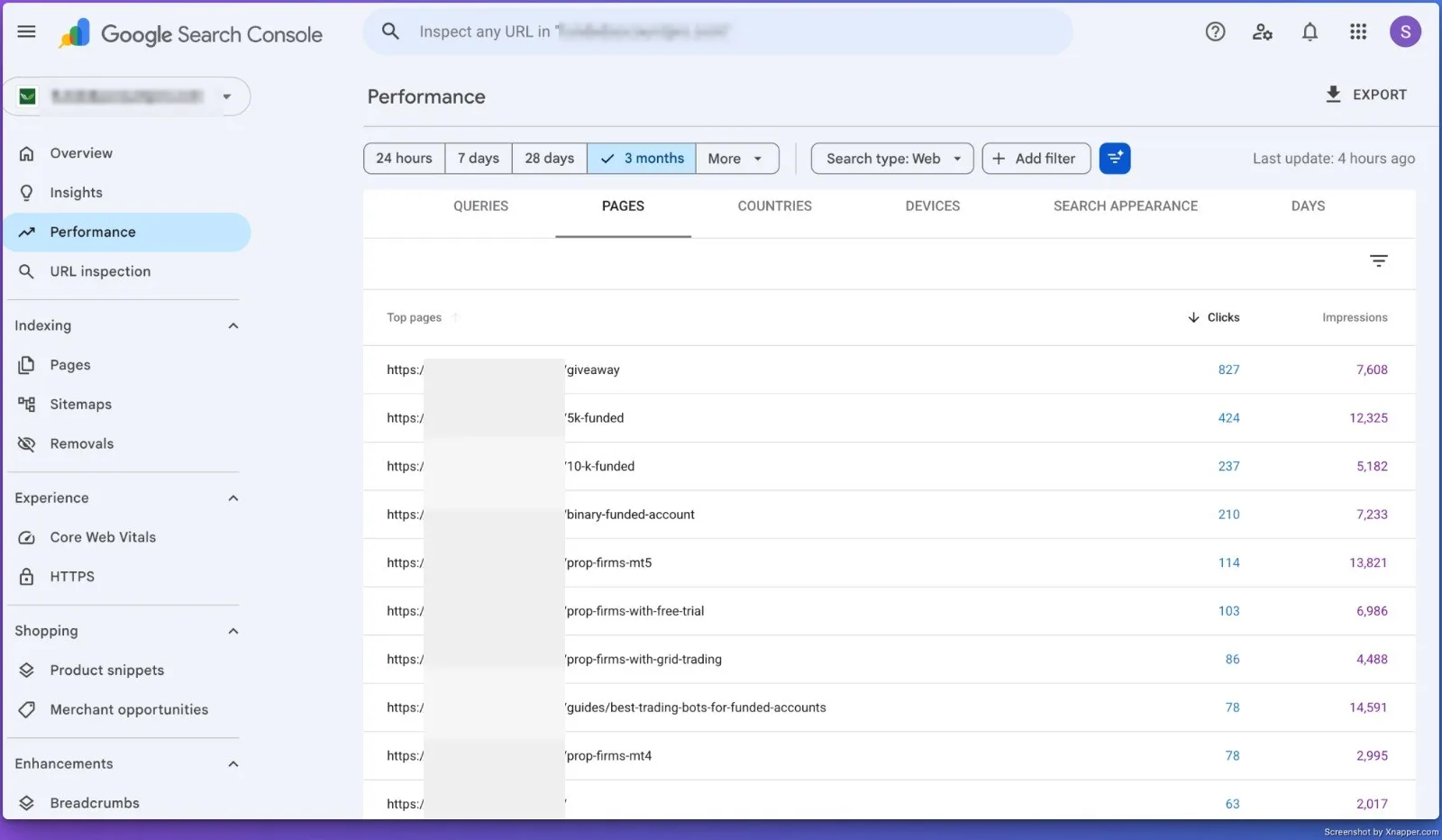
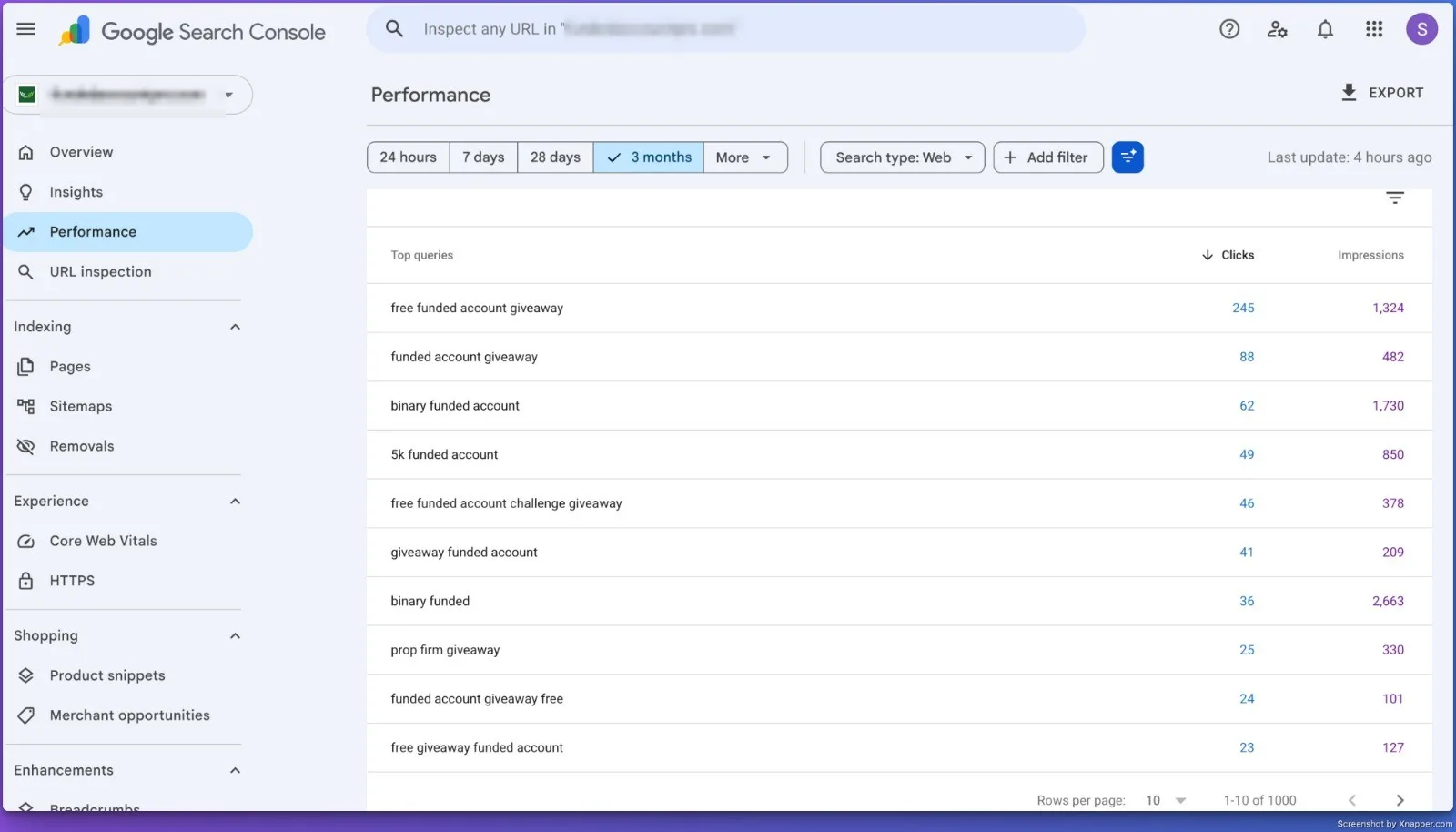
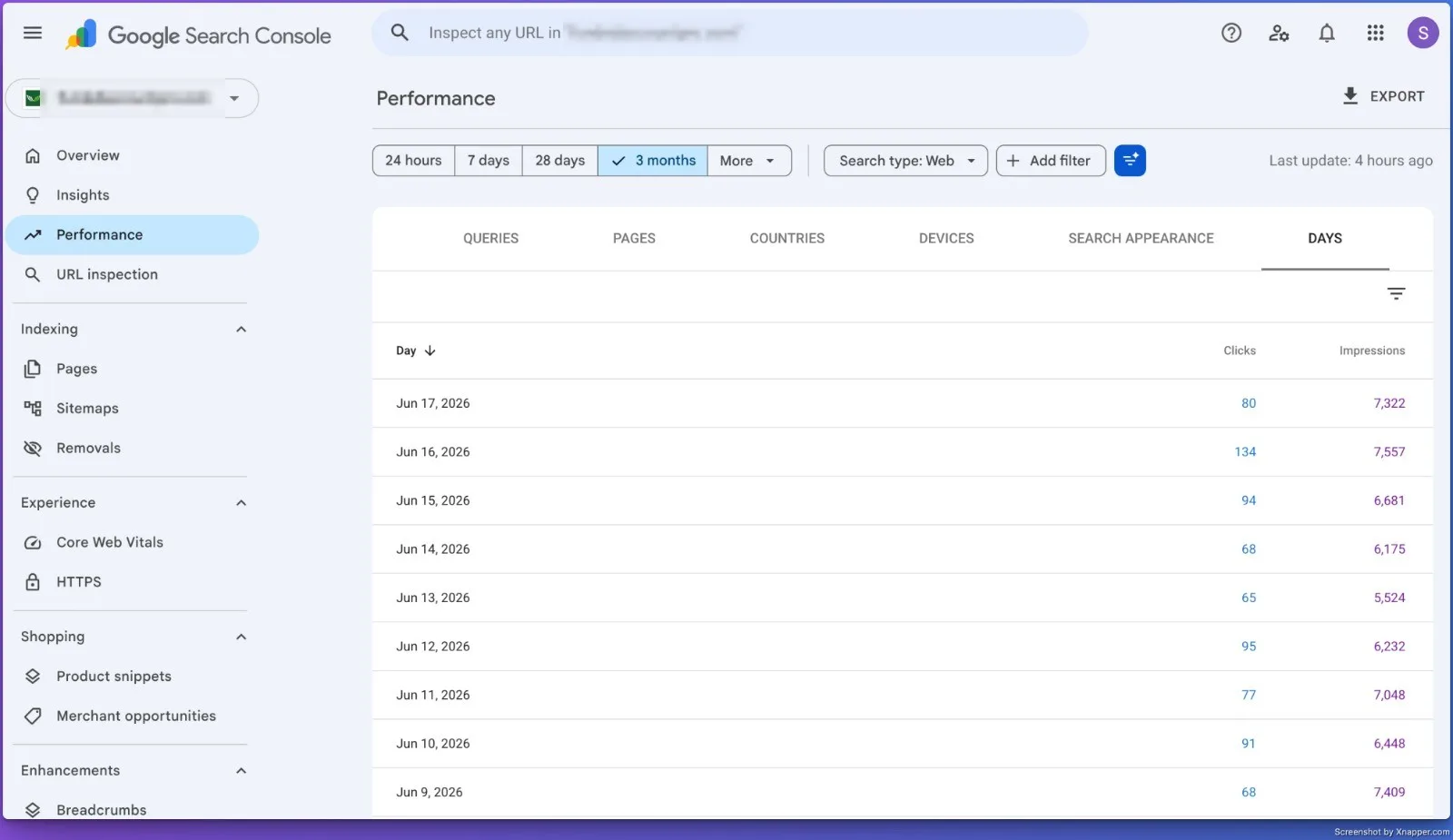
The full 6-month picture
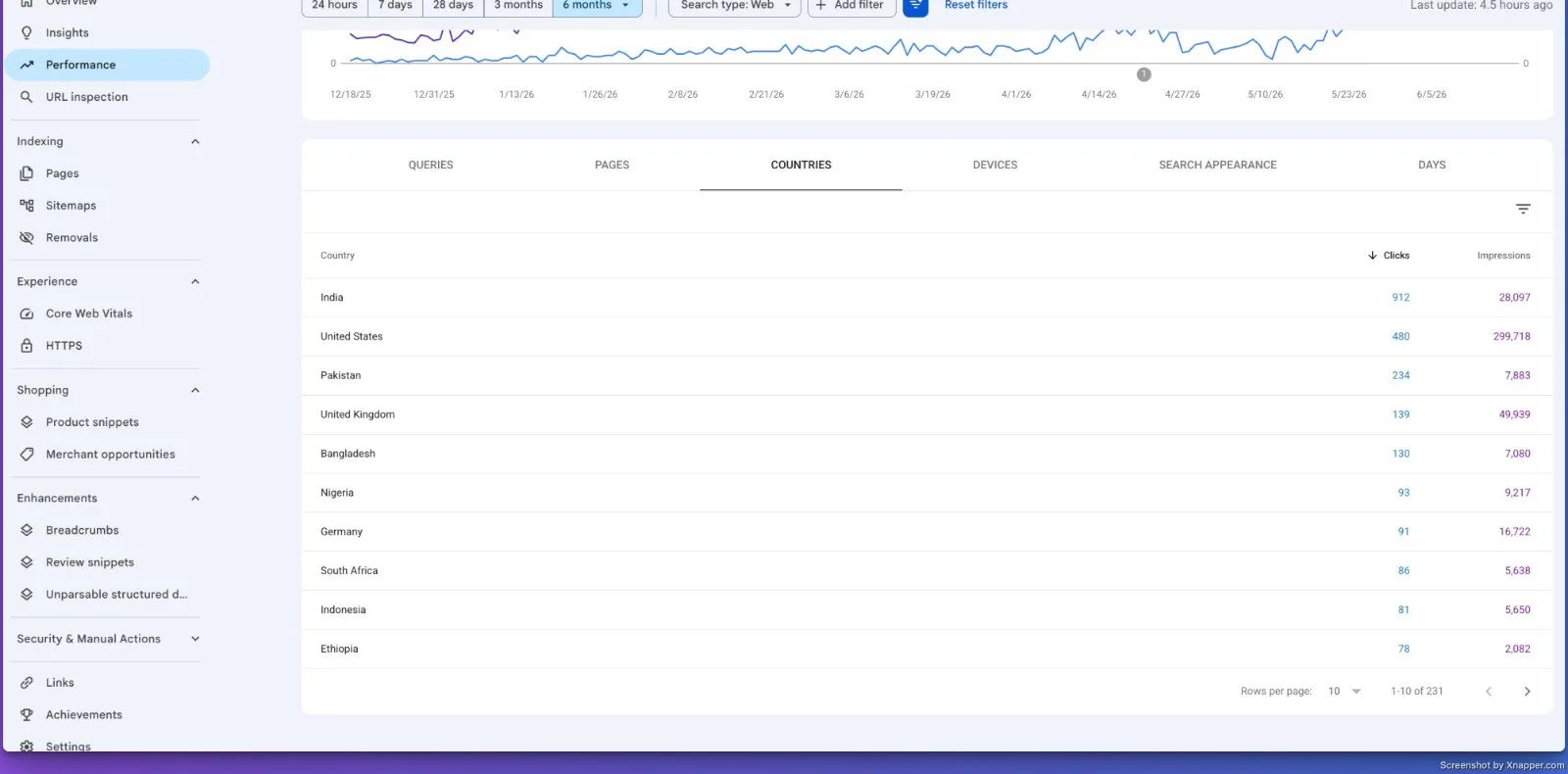
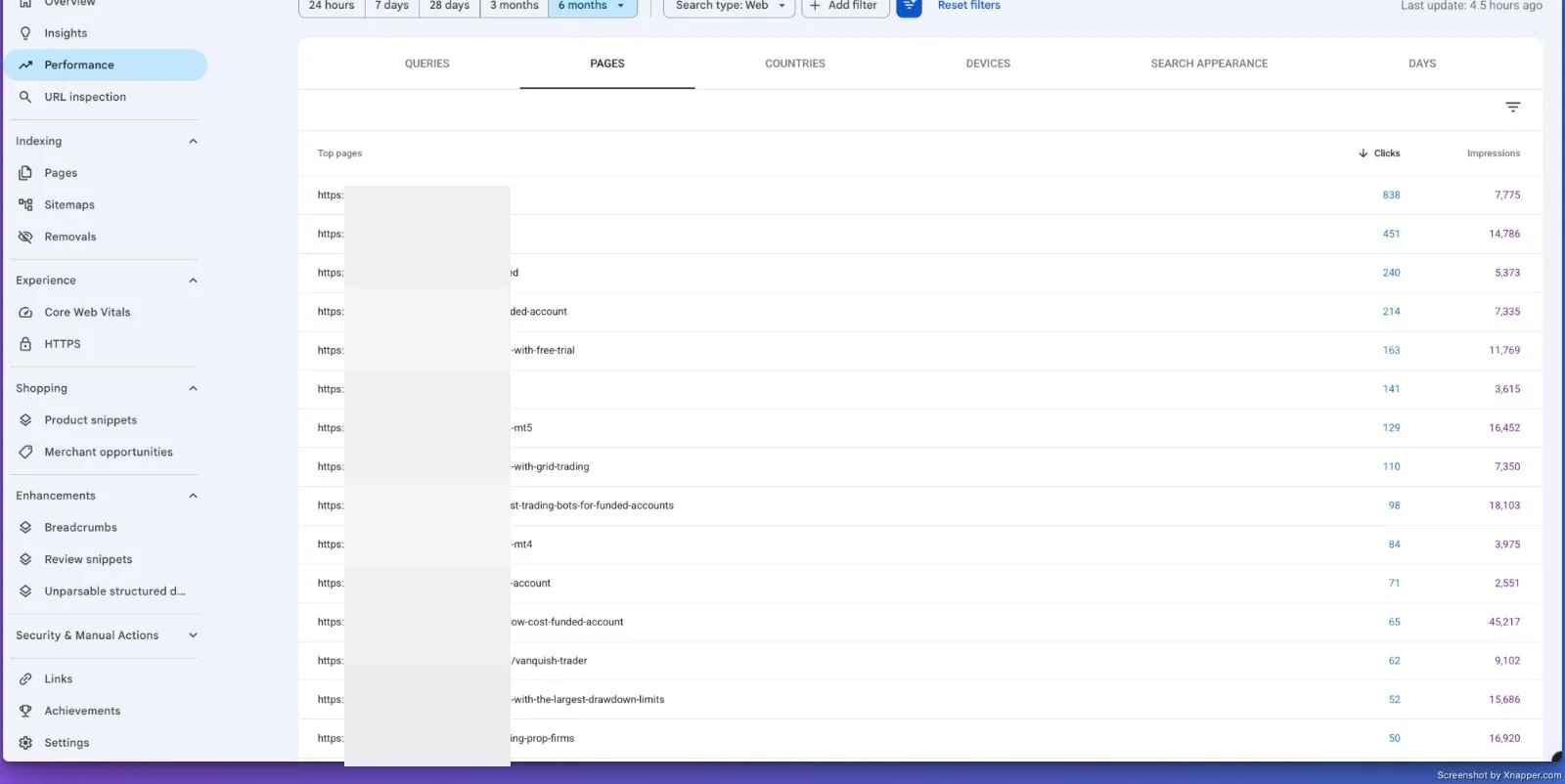
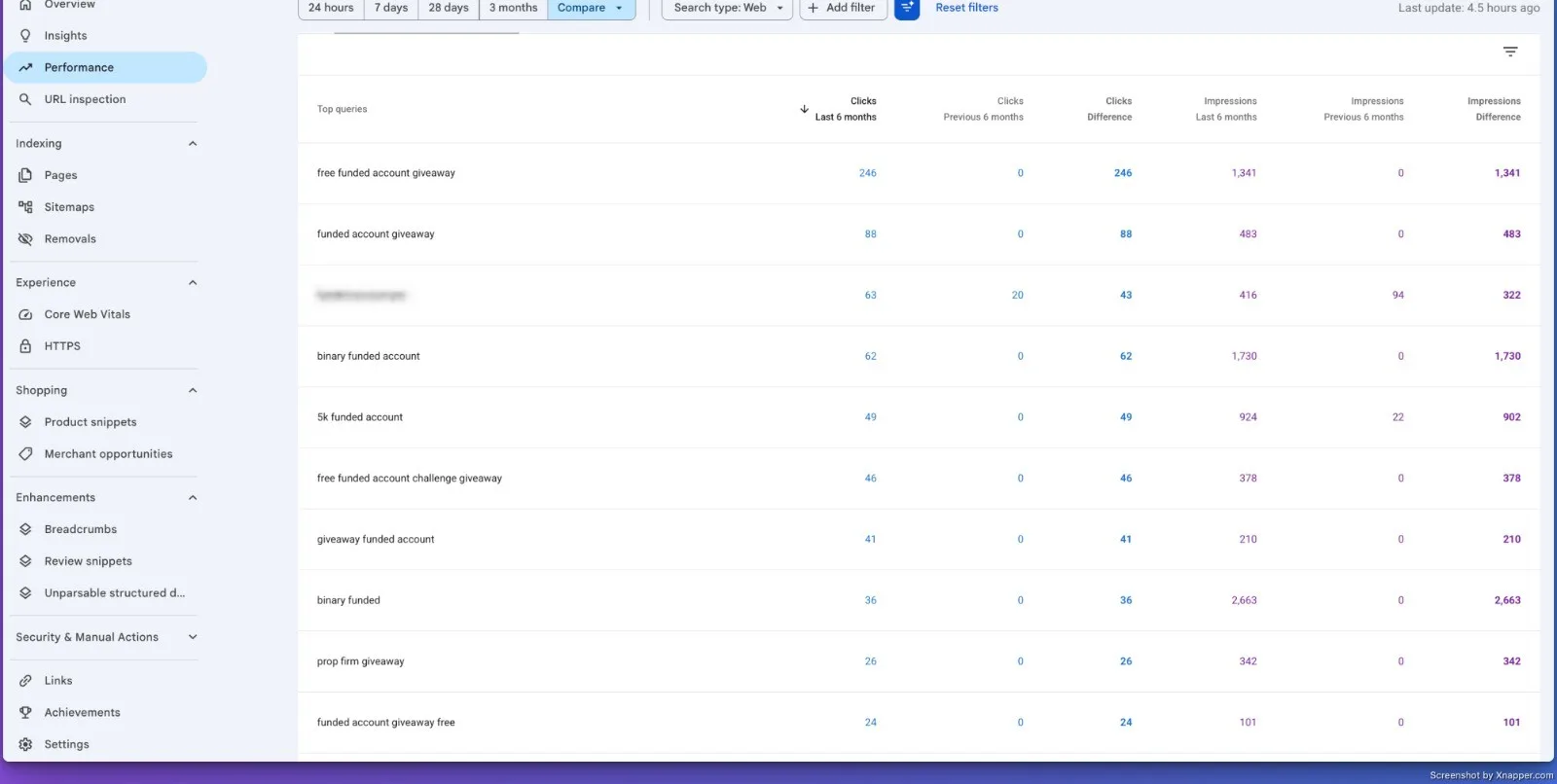
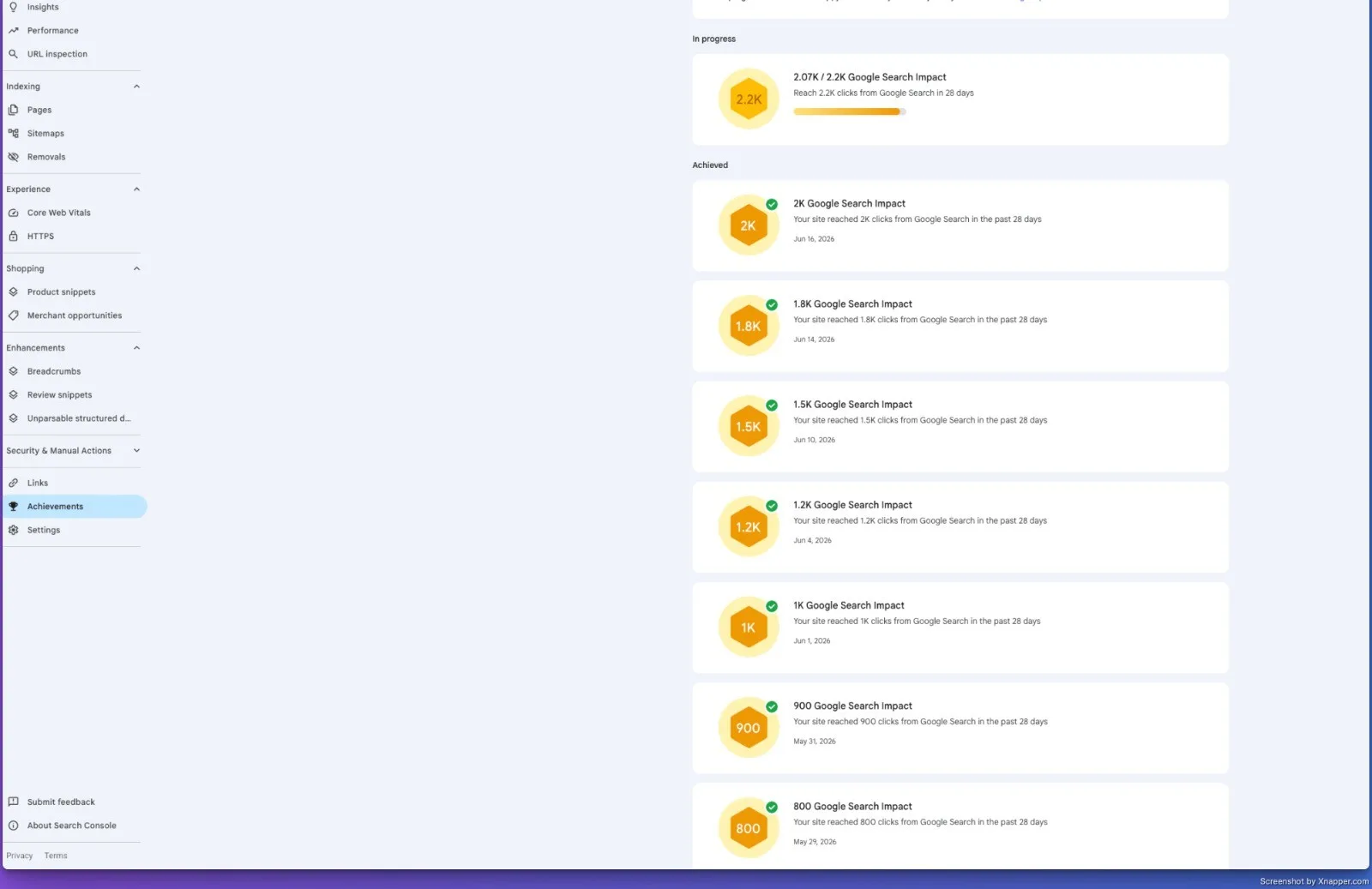
Zooming out to the full six-month window, the same compounding shows up across every report — totals, geography, top pages, query growth, and Search Console's own milestone tracker. Client domain is cropped or blurred throughout (NDA).
Most recent 28 days
Still Accelerating
The growth curve hasn't plateaued. In the latest 28-day window, clicks and impressions are still climbing strong double digits — led by the giveaway hook and the entity/funded-account pages.
Clicks · 28 days
2.07K ↑ 80%
Impressions · 28 days
185K ↑ 55%
Fastest-growing pages (28-day click growth)
Prop Firm Giveaway
/giveaway
trending_up578%
597
5K Funded Trading Account
/5k-funded
trending_up345%
294
Binary Options Funded Account
/binary-funded-account
trending_up2,100%
198
10K Funded Account
/10-k-funded
trending_up708%
194
Prop Firms with MetaTrader 5
/prop-firms-mt5
trending_up371%
80
Search Console Insights, last 28 days. Click totals per page; growth vs. previous period. Client domain withheld (NDA).
Key Insights
01
YMYL niches reward depth, not volume
One well-structured entity page covering every attribute of a firm outperforms five thin reviews. Google's YMYL evaluation weights completeness and accuracy over keyword frequency.
02
The topical map drives natural internal linking
When the architecture follows a semantic 3-section structure, internal links flow in the direction of authority. No artificial link injection needed — the architecture creates the linking patterns.
03
Zero off-page SEO is viable with complete coverage
409,000 impressions and 1,000+ ranking queries with no backlinks, outreach or guest posting. Topical completeness within a coherent architecture provided sufficient relevance signals.
04
Visual semantic clarity is a ranking factor
In financial niches that means clear challenge comparisons, scannable attribute tables and decision-supporting layouts — not keyword-heavy sales copy.
05
Entity-based architecture scales efficiently
New firms extend Section 1, new angles extend Section 2, new topics extend Section 3. The structure grows without a rebuild.
What I'd Do Differently
- Launch the giveaway hook earlier. The /giveaway page became the top traffic driver (827 clicks). Live from month one, it would have generated early traffic signals sooner.
- Invest in CTR optimization at month 6. With 409K impressions at 0.7% CTR, better titles and meta descriptions on high-impression pages (e.g. /prop-firms-mt5 at 13,821 impressions) is the biggest remaining growth lever.
- Add structured data from launch. Review, FAQPage and FinancialProduct schema would have accelerated rich-result and featured-snippet capture for the entity pages.
Methodology based on Koray Tuberk Gübür's topical authority and phrase-based semantic SEO framework.
Frequently Asked Questions
How long does topical authority take for a new affiliate site? add
For a new domain in a competitive YMYL niche, visible ranking momentum typically begins at month 3–4 for long-tail queries, with broader coverage and higher-competition keywords gaining traction by month 6–9. This project followed that timeline.
Can topical authority replace backlinks in competitive niches? add
In this case, yes — zero off-page SEO produced 409,000 impressions and 1,000+ ranking queries in under 12 months. Off-page signals can still accelerate results; the topical map creates the semantic foundation, and relevant backlinks add trust signals for YMYL content.
What is the minimum number of topics needed? add
This project used ~90 topics across 3 sections covering 30+ firm entities. For a smaller build covering 10–15 firms, a 30–40 topic map targeting the highest-intent queries in all three sections is a viable foundation.
Does this approach work for other financial affiliate niches? add
Yes. The entity-page / listicle / informational structure applies to any financial affiliate niche with multiple competing products — forex brokers, crypto exchanges, binary options, trading platforms and investment products all follow the same structural logic.
What tools were used for topical map research? add
SERP analysis (manual and tool-assisted), competitor page audits, People Also Ask data, autocomplete research and keyword clustering. No single tool produces a topical map — it requires human strategic judgment applied to research data.
Building an affiliate site in a competitive niche?
I build topical map strategies around your specific entity space — topical map research & architecture, YMYL content strategy, semantic SEO audits, and internal link architecture.
Book a Strategy Call arrow_forward