
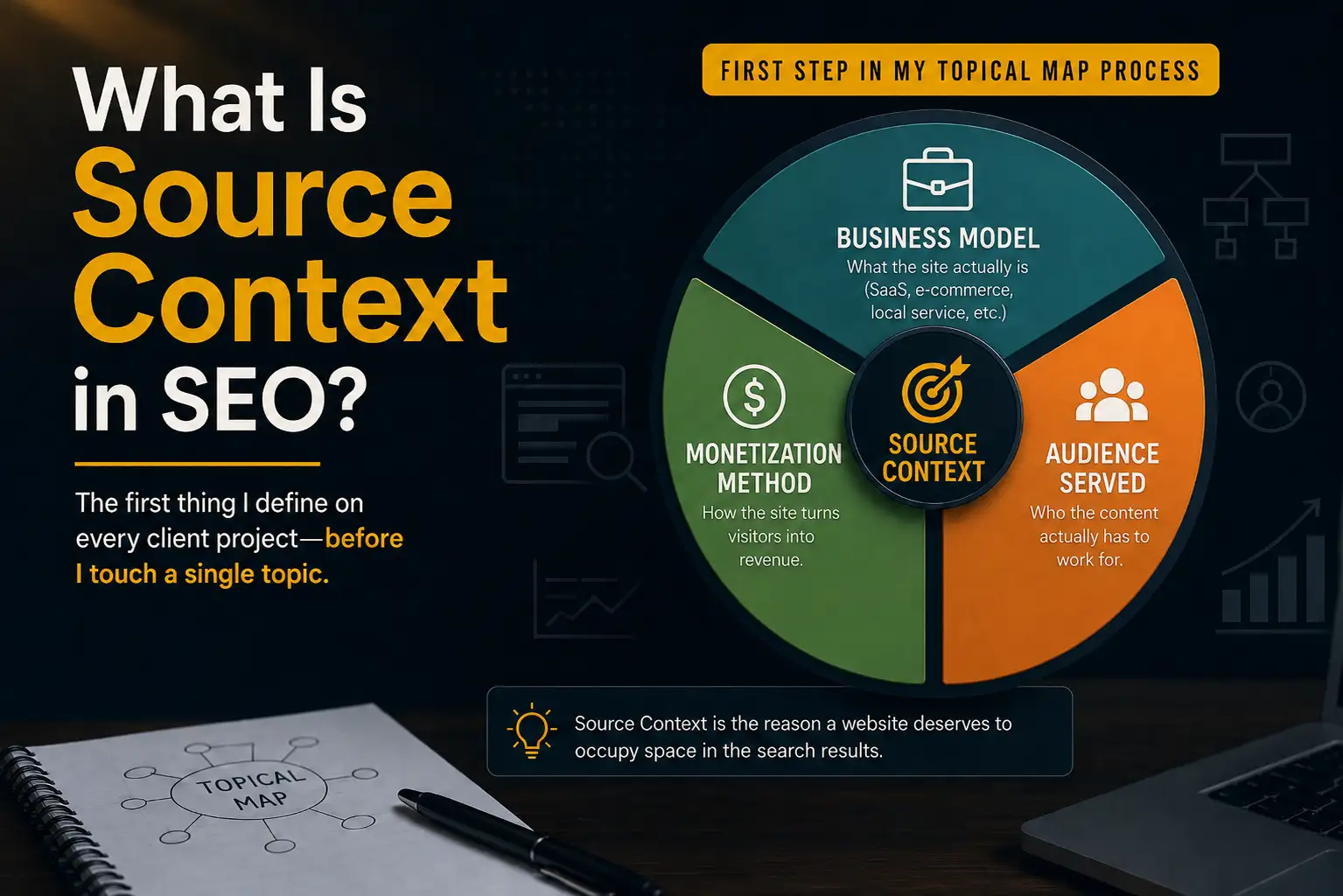

Source Context is the reason a website deserves to occupy space in the search results, its business model, its monetization method, and the audience it serves. It’s the first thing I define on every client project, before I look at a single topic.
Why I Define This Before Touching a Single Topic
I don’t open a keyword tool until I’ve answered this. Source Context is the standard I test every candidate topic against later, and without it, there’s no way to tell whether a high-volume topic actually belongs on a client’s site or just looks good in a spreadsheet.
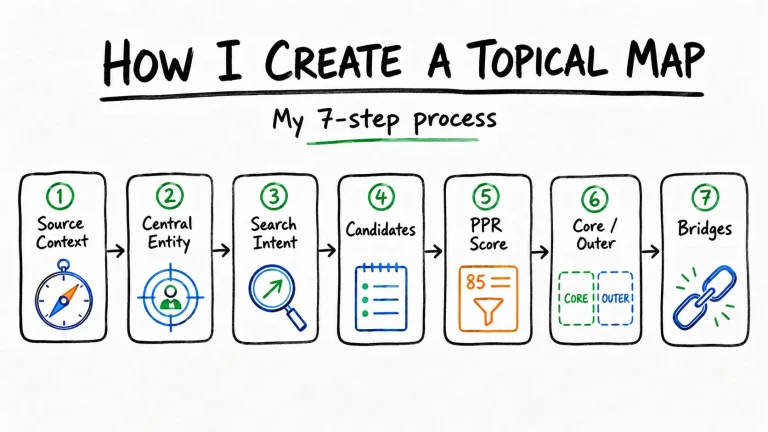
It’s the first of the 5 inputs I use to build a topical map, ahead of Central Entity and Central Search Intent. I’ve inherited client accounts where the Central Entity was identified correctly, project management software, for instance, and the map still ended up diluted, because nobody had answered why that specific site was allowed to talk about it.
What Source Context Actually Defines
I answer 3 questions for every client before I build anything.
Business model. What the site actually is, structurally, SaaS, e-commerce, local service, publisher, affiliate. This shapes what content can realistically build authority for it.
Monetization method. How the site turns visitors into revenue. Two clients with an identical Central Entity can need completely different maps if one sells subscriptions and the other sells one-off consulting.
Audience served. Who the content actually has to work for, which sets the depth and commercial intent of every topic I include.
An Example From My Own Process
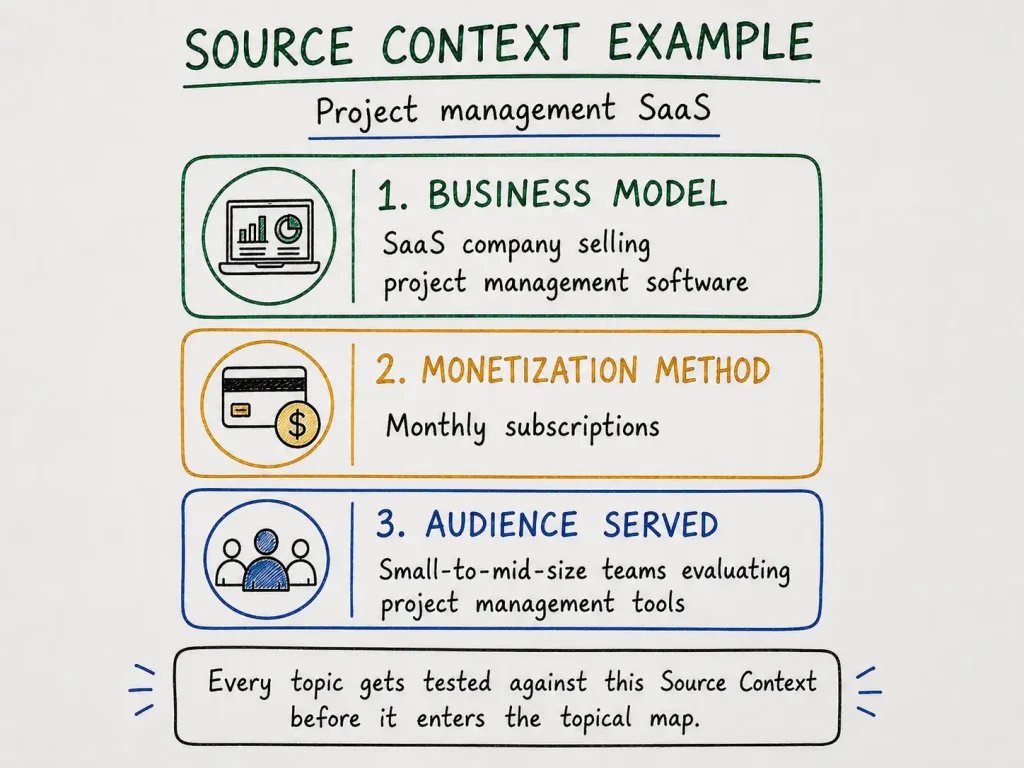
For a project management SaaS client, I’d write the Source Context like this: a SaaS company selling project management software on a monthly subscription, targeting small-to-mid-size teams. Every topic I consider for that map, from feature comparison pages to sprint retrospective guides, gets tested against that one sentence before it earns a place in Core or Outer.
What Happens When I Skip This Step
Without Source Context, I have nothing to score Relevance against, and Relevance is one of the two heaviest-weighted factors in my PPR formula, at 40%. Skip it, and every topic I’m evaluating defaults to scoring on Prominence and Popularity alone, which is exactly how I’ve seen other agencies end up publishing high-volume, low-fit content that never builds real authority.
This is the same mechanism behind the work-life-balance topic I rejected in my framework for what a topical map is: strong search demand, no connection to the client’s Source Context, cut before it reached a page.
Want a Topical Map Built This Way?
Every map I build starts with Source Context defined first, before anything gets scored. If that’s the process you want for your own site, you can read more about how I work through my semantic SEO consulting page .
Work With MeFrequently Asked Questions
Is Source Context the same as a niche?
No. A niche is a general subject area. Source Context is the specific business model, monetization method, and audience behind a particular site within that niche. I’ve had two clients in the same niche end up with completely different Source Contexts.
Does Source Context ever change?
Yes, and when it does, I go back and review the map against it. A client entering a new market or adding a new revenue stream needs their Source Context redefined, not just a few new topics bolted on.
Do you write Source Context into the actual page content?
No. It’s a strategic input I use once, at the start, to decide which topics belong on a site. It never appears as content on the page itself.
What’s the difference between Source Context and Central Entity?
Source Context answers why a site is allowed to talk about its subject. Central Entity answers what that subject actually is. I define both before I ever get to Central Search Intent.
Propagate the Intel

Transmission Feed